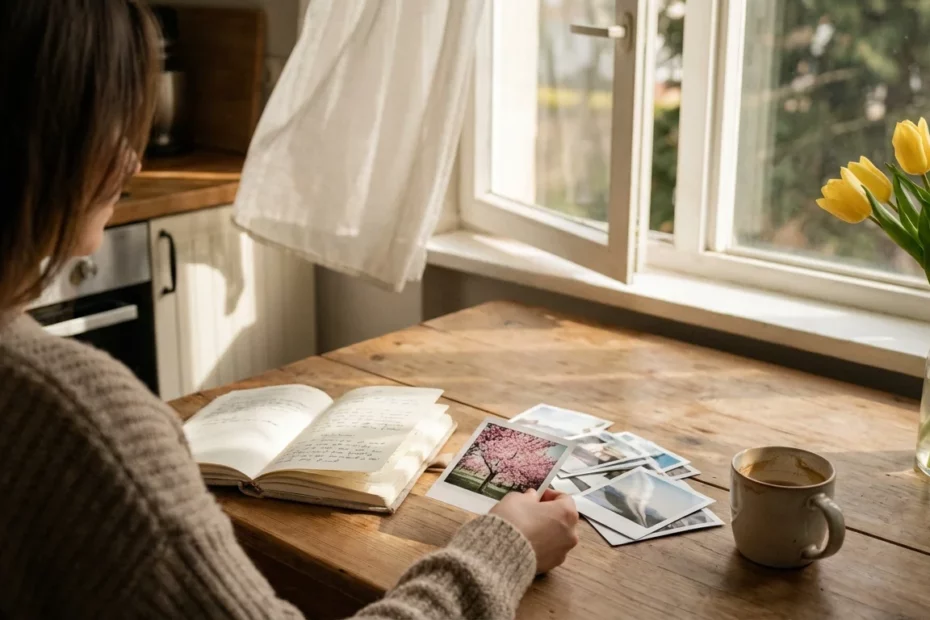
Most people take thousands of photos and remember almost none of them. Scroll back three years and it can feel like looking at a stranger’s life.
That feeling has a name: camera-roll chaos. And it’s not a storage problem. It’s a meaning problem.
This post is about what happens when you choose one photo a day, every day, for years. Not what the daily photo journal habit feels like in week one. What it reveals in year five, year eight, year ten and beyond. The patterns you can only see in retrospect. The moments you almost deleted that turned out to matter most.
If you’re new to the concept, start with The Daily Photo Challenge to understand the one-photo constraint. Then come back here for what waits on the other side of consistency.
Ready to start your own record?
4.5 stars on the App Store, trusted by daily journalers in 163 countries.
What Your Daily Photo Journal Reveals After Year One
The subject matter shifts first
In the beginning, most people photograph the obvious things. Birthdays. Dinners. A pretty sunset. They’re still thinking like social media posters, reaching for the highlight.
Around month three or four, however, something shifts. Instead of waiting for the perfect moment, you start noticing the actual one. A Tuesday morning coffee. Your dog’s face when it rains. The light on the kitchen wall at 7am.
Ordinary days start to feel significant
Looking back at year one, most daily journalers notice two things. First, how many quiet, ordinary days they’re glad they captured. Second, how many big occasions look almost identical in photos, while the small ones feel genuinely unique.
One year of daily photos gives you 365 deliberate choices stacked in a row. That stack, it turns out, is already a story.
What Changes After Five Years of Daily Photo Journaling
You start to see yourself clearly
Five years of daily photos is a fundamentally different kind of record. You can see how your home changed. How your kids’ faces changed. How your own face changed, season by season.
More than the visual record, you start to see your own patterns. The seasons you were clearly happy. The stretches that looked grey and tired. You don’t need a journal entry to read the mood, because the photos tell you directly.
Seasons of life become visible
Some years are full of outdoors, movement, new places. Others are interior, still, close to home. You didn’t notice it while living it. Looking back across five years of one photo a day, however, the shape of your life becomes legible in a way nothing else produces.
What 8-12 Years of Daily Photos Actually Shows You
The things you forgot matter most
At eight to twelve years in, you’ve forgotten most of what you photographed. That’s precisely the point. When you flip back through a printed yearbook from several years ago, you’re not reviewing your life. You’re rediscovering it.
The moments that hit hardest are almost never the ones you expected. Not the birthday parties, though those are there too. It’s the random Wednesday. A child’s expression. The meal you cooked for no particular reason.
Your photo journal becomes a family document
By this point, your daily photos are also a record for everyone around you. Your kids are growing up in your archive. Your friendships, your neighborhood, your parents’ faces: all documented, year after year.
This is why users report keeping the daily photo journal habit for 8-12+ years. It’s not discipline that sustains them. It’s that the record becomes too valuable to stop building. PYM daily journalers have collectively captured more than 50M photos, each one a single day chosen deliberately.
At this stage, the printed yearbooks become something else entirely.
4.5 stars on the App Store, with 50M+ photos captured by daily journalers in 163 countries.
The Photos That Surprised Daily Journalers Most
Ordinary Tuesdays
The photos that generate the most feeling, looking back, are the unremarkable ones. A child doing homework. A partner reading on the couch. The backyard in autumn. These felt like filler at the time.
In retrospect, they’re the whole story. They carry the texture of a life that no highlight reel captures.
Faces
People’s faces change slowly enough that you don’t notice day to day. Year over year, however, the difference is stark. Parents age. Kids grow up fast. Friends come and go.
A decade of one photo a day means you have a real record of how the people you love actually looked at different moments in their lives. Not posed. Not filtered. Just them, on an ordinary day, in the middle of living.
The Hard Years
Not every year is good. Some stretches show up clearly in the photos: fewer people, less light, more still interiors. You can read the hard seasons without needing to label them.
Notably, many daily journalers say those years are the ones they’re most grateful they documented. Because they survived, and now they can see that too.
What This Means for Your Family
Spring is a natural starting point
Spring brings new chapters. Kids finish school years. Families gather over holidays. In many households, April marks a clear rhythm: the year is one quarter done, summer is on the horizon, and the impulse to document life suddenly feels urgent.
That impulse is worth acting on.
The generational case for daily photo journaling
Your daily photo journal is not just for you. It’s for the people who come after you. Your kids will one day want to know what daily life looked like when they were small. Your parents’ generation didn’t have a simple way to document this. You do.
Furthermore, the habit models something valuable for children: noticing the present. One photo a day is a small act of attention. Over years, it adds up to a life examined, not merely lived.
Printed yearbooks as physical memory
Digital photos are invisible. They exist, but you don’t experience them. A printed yearbook sits on a shelf. You pull it out. You hand it to someone. It becomes part of the household in a way no photo folder ever will.
PYM prints on FUJIFILM luxury satin photo paper. These books are built to last. The whole point is that your records outlast the phone they came from.
FAQ
What do you actually discover from years of daily photo journaling?
Looking back across years of one daily photo, most people notice three things: personal patterns they couldn’t see while living them (emotional seasons, recurring habits, evolving priorities); how much ordinary life they would have forgotten without the record; and how quickly the people around them changed. The daily photo journal format forces one deliberate choice per day, which means your archive reflects what actually mattered, not just what looked good.
Is it worth starting a daily photo journal if you’ve already missed years?
Yes. The record you build from today is more valuable than a perfect archive starting from birth. Many long-term daily journalers started in their 30s or 40s and describe it as one of the best decisions they made. You can’t go back and document years you didn’t photograph. However, you can start the record that your future self will be grateful for.
How does a daily photo journal differ from just keeping photos on your phone?
A camera roll is passive storage. A daily photo journal is an active choice. One photo per day means you decide what mattered. That decision, repeated every day for years, creates a curated record of your life rather than a pile of undifferentiated images. Additionally, when connected to a printed yearbook, the habit produces something physical and permanent, not just a file you’ll eventually lose or forget to back up.
Start the Record Now
Most people think they’ll start someday. They’ll organize the camera roll, pick the best photos, make the book. Someday never comes.
One photo a day is different because it builds itself as you live. There’s no backlog to face. No blank canvas to fill. Just today’s one moment, added to yesterday’s, added to the day before.
50M+ photos captured by daily journalers in 163 countries.
Related Reading
- The Daily Photo Challenge: One Photo a Day Changes Everything
- How to Build a Daily Photo Habit That Actually Sticks
- From Camera Roll to Printed Yearbook: How PYM Works
Related reading: